
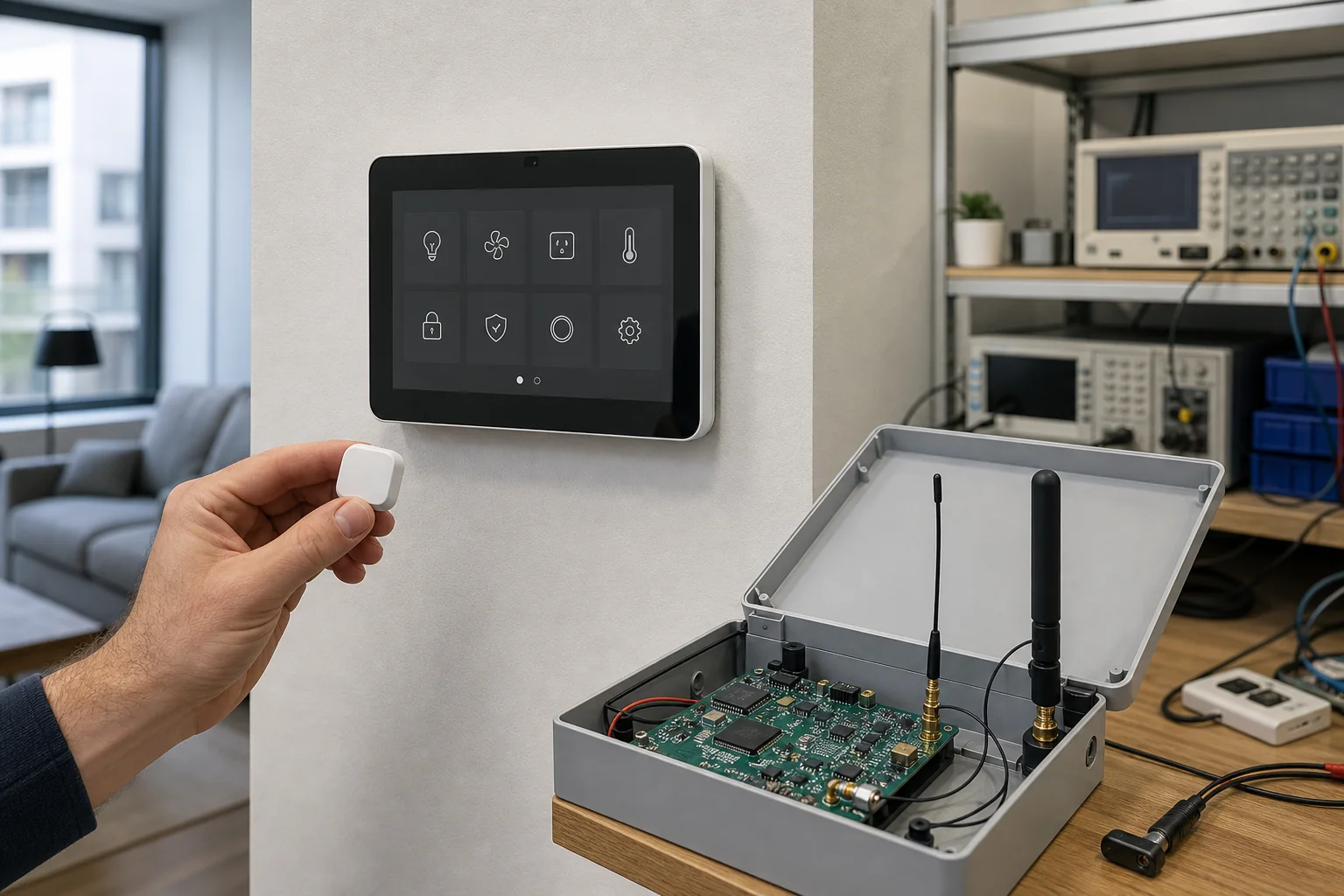
Wireless planning for a smart control panel often begins with four checkboxes: Wi-Fi, Bluetooth, Zigbee, and Matter. That list is useful for a sales sheet and inadequate for engineering. The radios do different jobs, some share the same 2.4 GHz spectrum, and Matter is not simply a fourth radio beside the other three.
First define whether the panel is a user interface, local controller, gateway, Matter controller, bridge, or a combination. A cloud-connected UI needs different hardware and software from a panel that commissions devices and keeps automation running offline.
When selecting smart control panels, define those roles before choosing the module. A crowded feature list on an untested antenna design is less useful than two radios with clear ownership, stable recovery, and a production test method.
Give each wireless technology a job
Wi-Fi normally carries IP traffic between the panel, router, local gateway, and cloud. It suits app data, media, video preview, system updates, logs, and APIs, but availability depends on the building network. An OEM should specify bands, security mode, provisioning method, roaming expectations, reconnect behavior, and whether Ethernet is available as a fallback.
Bluetooth may support commissioning, a phone link, locks, sensors, or service tools. Bluetooth Classic and Bluetooth Low Energy are not interchangeable. Name the profile or GATT service, connection count, pairing flow, and central or peripheral role.
Zigbee uses an IEEE 802.15.4 radio and is common in lighting, sensors, switches, and established smart-home installations. The control panel may talk directly to Zigbee devices, connect to a separate coordinator, or display state supplied by another gateway. Those options require different stack ownership and failure handling.
Matter operates over IP networks such as Wi-Fi, Ethernet, and Thread; Bluetooth Low Energy is commonly involved in setup. The Connectivity Standards Alliance provides a concise Matter technology overview. “Matter support” alone does not say whether the panel needs Thread, border-router capability, controller software, bridge behavior, or only compatibility with a separate hub.
| Technology | Typical panel role | Questions to freeze before hardware |
|---|---|---|
| Wi-Fi | IP network, cloud, local gateway, updates | 2.4/5 GHz bands, security, provisioning, offline behavior |
| Bluetooth LE | Commissioning, phone link, nearby accessories | Central/peripheral role, profiles, simultaneous links, range |
| Zigbee | Local device network or legacy ecosystem | Coordinator/router role, stack, device types, gateway ownership |
| Matter | Common application layer over Wi-Fi/Ethernet/Thread | Controller, commissioner, bridge, Thread and border-router needs |
Do not buy a protocol name as a hardware specification
Module selection starts after the architecture is clear. A Wi-Fi/Bluetooth module may suit a panel using a separate Zigbee gateway. Direct Zigbee or Thread communication needs IEEE 802.15.4 capability in a multiprotocol part or separate radio, plus memory and secure storage for the chosen stacks.
Ask for the exact module, antenna interface, BSP, firmware ownership, regulatory reports, and lifecycle status. “Hardware supports 802.15.4” does not prove that the required Zigbee or Thread stack is available for the target OS release.
For an Android SBC design, confirm how radio services reach the application. Wi-Fi and Bluetooth are usually integrated through the Android framework, while Zigbee or Thread may use a vendor daemon, USB/UART coprocessor, native service, or customer SDK. That boundary affects permissions, update ownership, logs, and recovery.
Treat 2.4 GHz coexistence as a system problem
Wi-Fi, Bluetooth, Zigbee, and Thread can all occupy 2.4 GHz. Performance depends on traffic, channel selection, coexistence mechanisms, antennas, and placement. A quiet-office demonstration is not a substitute for a busy apartment building.
Prefer a module or chipset combination with a proven coexistence path. If separate radios are used, review antenna isolation, trace routing, ground clearance, shielding, transmit power, and software scheduling. Two antennas placed close together behind a metal mounting plate can perform worse than a carefully validated shared solution.
The final wall assembly matters. A metal back box, display frame, cable bundle, or power supply can alter radiation patterns. Place the antenna from the enclosure geometry, not the empty PCB, and protect its keep-out from copper, brackets, and noisy circuits.
Decide what works without cloud access
An OEM control panel needs an explicit offline matrix. Can the user still control lights and HVAC when WAN access fails? Does the panel retain schedules and scenes? Can it discover the local gateway after a router reboot? What happens if Wi-Fi credentials change or the Zigbee coordinator is replaced?
Document where device state, automation rules, credentials, and time are stored. A UI-only panel should show the offline state instead of leaving stale controls on screen; a local controller must protect its database and recover after abrupt power loss.
The panel software baseline should define startup order, service supervision, credential storage, logs, update dependencies, and how the UI reports a failed network. That avoids a common field problem: the radio reconnects, but the application service never rebuilds its session.
Plan commissioning before the UI is finished
Commissioning is part of the product. Identify who installs the panel, which tool is used, how it joins Wi-Fi, who creates the fabric or device network, and how ownership transfers. A 200-room hotel needs a different flow from one home.
Include recovery for wrong credentials, interrupted pairing, router replacement, and factory reset. Define which reset clears network settings and which removes device credentials and customer data.
Certification scope belongs in the RFQ
A pre-certified module can reduce RF work, but it does not certify the finished panel automatically. Antenna, enclosure, host layout, country settings, transmit power, and simultaneous operation affect compliance. Protocol branding is also separate from radio regulation.
Procurement should separate module and finished-product certifications, report ownership, branding-program fees, and retest responsibility. Regional SKUs may be necessary when channel plans, power limits, or antennas differ.
Build a realistic validation matrix
Wireless acceptance should use the final enclosure, production-like image, intended router class, and actual devices. At minimum, run:
- First-time commissioning and repeated factory-reset commissioning
- Router power-cycle, WAN loss, access-point change, and credential change
- Weak-signal operation at realistic wall locations
- Simultaneous Wi-Fi traffic and Bluetooth/Zigbee/Thread activity
- Crowded 2.4 GHz channels and neighboring-network interference
- Overnight reconnect, application recovery, and long-duration messaging
- OTA update interruption and rollback or recovery behavior
- Offline scenes, local control, and restoration after cloud return
- Production checks for radio identity, antenna connection, transmit/receive, and image version
During control-panel production testing, avoid a test that merely finds one access point. A unit can pass discovery while having a damaged antenna connector, poor receive sensitivity, wrong country configuration, or unstable firmware. Use a known fixture distance and record the software build and radio identity with the result.
Information an OEM should send the supplier
The RFQ should include a network diagram, panel and protocol roles, device list, router assumptions, countries, enclosure CAD, antenna restrictions, software platform, commissioning flow, offline requirements, certification target, and acceptance tests.
If the enclosure or radio topology must be unique, a custom SBC can place modules, antennas, debug access, and production test points around the real wall installation. That decision should happen before tooling, because the antenna position and cable path can influence both plastic and PCB design.
Final recommendation
Plan wireless features by product role, not protocol count. Decide which device performs commissioning, control, bridging, border routing, cloud access, and offline automation. Then choose modules and antennas with a supported software path, realistic certification scope, and final-enclosure test evidence. This approach may produce a shorter specification, but it produces a control panel that is much easier to deploy and support.
Frequently Asked Questions
Does a Matter smart control panel need a separate Matter radio?
Not necessarily. Matter is an application-layer connectivity standard that can use Wi-Fi, Ethernet, or Thread for operational networking, while Bluetooth Low Energy is commonly used during commissioning. A Thread-based design still needs a compatible IEEE 802.15.4 radio and the correct software role.
Can one module provide Wi-Fi, Bluetooth, Zigbee, and Matter?
Some module combinations cover Wi-Fi, Bluetooth, and IEEE 802.15.4, but hardware capability alone does not guarantee all four product functions. The BSP, protocol stacks, ecosystem role, security storage, certifications, antennas, and product software must also be validated.
Should an OEM control panel use Zigbee and Matter together?
It can when the product must support an installed Zigbee device base while adding Matter interoperability. The team must define whether bridging is required, which device types are exposed, where automation runs, and how credentials and updates are managed.
What wireless tests should be run before smart control panel production?
Test commissioning, reconnect, range, throughput, latency, antenna performance, crowded-channel behavior, simultaneous radio operation, power-cycle recovery, router replacement, offline control, firmware update, credential reset, and production radio checks in the final enclosure.
Frequently Asked Questions
Does a Matter smart control panel need a separate Matter radio?
Not necessarily. Matter is an application-layer connectivity standard that can use Wi-Fi, Ethernet, or Thread for operational networking, while Bluetooth Low Energy is commonly used during commissioning. A Thread-based design still needs a compatible IEEE 802.15.4 radio and the correct software role.
Can one module provide Wi-Fi, Bluetooth, Zigbee, and Matter?
Some module combinations cover Wi-Fi, Bluetooth, and IEEE 802.15.4, but hardware capability alone does not guarantee all four product functions. The BSP, protocol stacks, ecosystem role, security storage, certifications, antennas, and product software must also be validated.
Should an OEM control panel use Zigbee and Matter together?
It can when the product must support an installed Zigbee device base while adding Matter interoperability. The team must define whether bridging is required, which device types are exposed, where automation runs, and how credentials and updates are managed.
What wireless tests should be run before smart control panel production?
Test commissioning, reconnect, range, throughput, latency, antenna performance, crowded-channel behavior, simultaneous radio operation, power-cycle recovery, router replacement, offline control, firmware update, credential reset, and production radio checks in the final enclosure.