
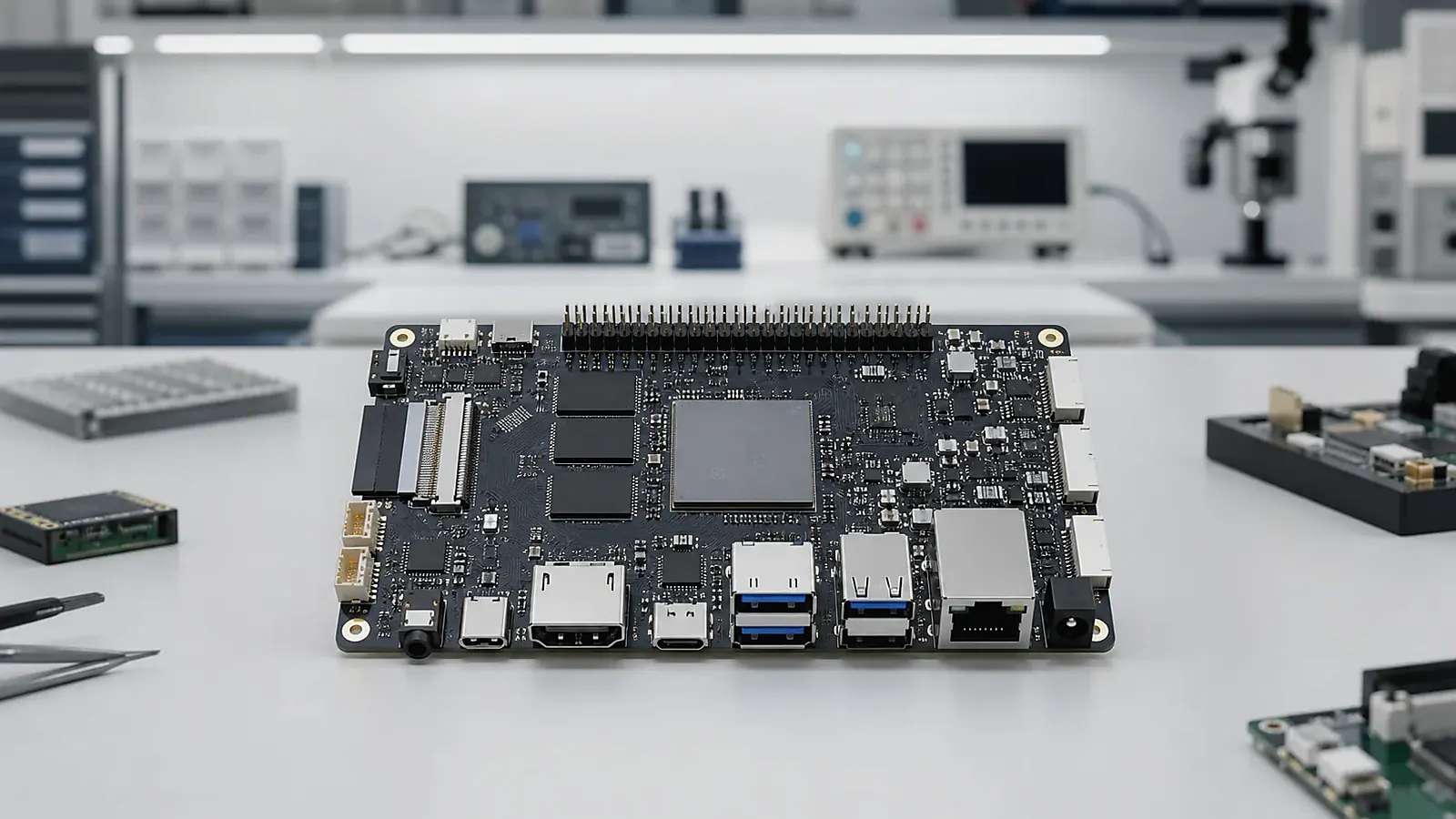
Rockchip and Allwinner SBC platforms can both support commercial embedded products, but they are not interchangeable decisions. The better direction depends on UI load, display requirements, multimedia, I/O, software support, target cost, lifecycle expectations, and the amount of customization required. A product team that only compares processor names will usually miss the real risks: BSP maturity, peripheral support, enclosure fit, component availability, and production testing.
A Rockchip board choice should be checked against the workload that will ship, not only a processor comparison table. For Rockchip or Allwinner SBC: Which Platform Fits Your Project?, the team should test display resolution, UI load, camera or media use, thermal behavior, and the exact Android or Linux SDK branch before calling the platform production-ready.
This comparison is written for teams choosing a platform before committing to samples, a custom board, or a production plan. Engineers may care most about interfaces and drivers. Project managers may care about schedule and support. Procurement may care about BOM cost and supply stability. A good platform decision needs all of those views.
Start from the product path
The first question is not “Rockchip or Allwinner?” It is “What kind of product are we building?” A display-rich Android terminal, an industrial Linux gateway, a compact audio product, a room control panel, and a custom controller all lead to different platform choices.
If the product is UI-heavy, start from the Android SBC direction. If the product runs background services, talks to equipment, and operates unattended, start from the Linux SBC direction. If the product needs fixed connector positions, a special display interface, a custom enclosure, or cost-optimized volume production, Custom SBC planning may matter more than the chip family itself.
Where Rockchip is usually stronger
Rockchip SBC projects are often a strong starting point when the product needs richer Android UI performance, higher display requirements, multimedia, camera support, stronger application processing, or a familiar Android/Linux development path. Rockchip platforms are common in Android HMI devices, smart terminals, commercial displays, industrial panels, edge devices, and custom embedded boards that need more headroom.
Rockchip is not only about raw performance. The practical benefit is often the combination of display capability, Android BSP direction, multimedia support, and a broad range of board options. If the product has a large screen, smooth UI, video, camera, browser content, multiple apps, or future software growth, Rockchip may reduce risk compared with forcing the product onto a lower-cost platform.
The tradeoff is that higher performance can bring higher board cost, thermal design work, and unnecessary complexity if the product is simple. A small gateway with no display may not need a high-end Rockchip board. A simple wall panel with a modest UI may not benefit from paying for unused headroom.
Where Allwinner is usually stronger
Allwinner SBC projects are often considered when the product has practical cost targets, compact display requirements, Linux control needs, audio-related functions, or a more focused interface set. Allwinner directions can fit Android display terminals, compact HMI products, Linux gateways, control devices, and RTOS-style smart products.
Avontek currently discusses A33, A64, R528, and R128 directions on the Allwinner SBC hub. A33 and A64 are more relevant to Android or Linux display products. R528 is often more relevant to Linux gateway, control, audio, and connected device work. R128 should be treated as a compact RTOS direction, not as a substitute for Android or Linux.
The tradeoff is that cost-sensitive decisions need strict validation. If a lower-cost platform requires custom display work, a different wireless module, extra carrier hardware, or more BSP development, the total project cost may rise. Allwinner can be a very good fit when the requirement is clear and the supplier support matches the product, but it should not be selected by price alone.
Comparison table for early selection
| Decision area | Rockchip direction | Allwinner direction |
|---|---|---|
| Android UI | Strong fit for richer UI, media, camera, smart terminal workloads | Good fit for cost-sensitive display and simpler terminal products |
| Linux gateway | Good when more processing or display output is needed | Good when I/O and cost are controlled |
| Audio/control | Possible, depending on platform | Often attractive for compact audio and focused control products |
| Performance margin | Usually stronger options available | Best when requirements are defined tightly |
| Cost target | May be higher depending on configuration | Often attractive for cost-sensitive designs |
| Custom board | Strong for richer products and mixed Android/Linux paths | Strong for compact, cost-focused, or task-specific designs |
This table should not replace sample testing. Two boards using similar SoC families can behave differently because of memory, storage, PMIC, wireless module, display routing, power design, and BSP version.
BSP and software support
For Android projects, ask about Android version, boot logo, app auto-start, display and touch support, permissions, system UI restrictions, camera, audio, wireless, and factory flashing. For Linux projects, ask about bootloader, kernel, device tree, root filesystem, services, logs, watchdog, update method, and driver support.
The official Android Open Source Project documentation gives useful platform background, but a production SBC project depends on board-level BSP work. Do not assume that a processor family automatically supports the exact display, touch controller, wireless module, or camera sensor selected for your product.
Production and procurement considerations
Procurement should compare total product cost rather than board price alone. Include display, cable, adapter boards, enclosure changes, power supply, test fixture, flashing time, support, component alternatives, and expected production volume. A board that looks cheaper during sample evaluation may be more expensive if it creates assembly or BSP work.
For lifecycle planning, ask which components are fixed and which have approved alternatives. Wireless modules, eMMC, PMIC, Ethernet PHY, touch controllers, and displays can all affect software validation. If the product needs multi-year production, component control needs to be part of the first platform decision.
Sample testing before the final choice
The safest comparison is to test both directions against the same product requirement. Use the same display, similar memory and storage, the same wireless expectations, the same application workflow, and the same production assumptions. Otherwise the comparison becomes unfair: one board may look better only because it was tested with an easier display or a lighter image.
For Android products, run the real APK or a close prototype. Check boot-to-app time, touch response, display rotation, Wi-Fi reconnection, audio, camera, and whether the UI remains smooth during normal use. For Linux products, test Ethernet recovery, serial communication, service startup, watchdog, logs, storage writes, and sudden power loss. These tests reveal platform fit more clearly than processor marketing material.
The final decision should also include supplier communication quality. A supplier that can explain BSP status, component alternatives, test scope, and known limitations is usually a safer partner than one that only confirms every requirement quickly. For production work, clear negative answers are useful too, because they show where testing or customization is still needed.
Final recommendation
Choose Rockchip when richer UI, media, camera, performance headroom, or a broader Android/Linux path matters. Choose Allwinner when the requirement is controlled, cost matters, and the platform support matches the display, I/O, and software stack. In both cases, validate the choice with real application tests, real peripherals, production flashing, and supplier support. For deeper platform-specific planning, read Rockchip SoC comparison across current and legacy platforms and A33, A64, R528, and R128 platform comparison.
Frequently Asked Questions
What details are useful before we talk about an Allwinner SBC build?
Send the use case, OS preference, display or I/O list, enclosure limits, power input, wireless needs, target quantity, and timing. With that context, Avontek can suggest a Allwinner SBC hardware path that fits the real device instead of only comparing board specifications.
When is a custom SBC worth considering for an Allwinner SBC product?
A custom SBC is worth reviewing when the device needs a fixed PCBA outline, connector position, display interface, power input, wireless module, mounting method, or cost target that a catalog board cannot meet cleanly.
Can Avontek stay involved after Allwinner SBC samples are built?
Yes. Avontek can help with Allwinner SBC board choice, Android or Linux BSP discussion, peripheral checks, sample bring-up, test fixtures, image review, and factory coordination.