
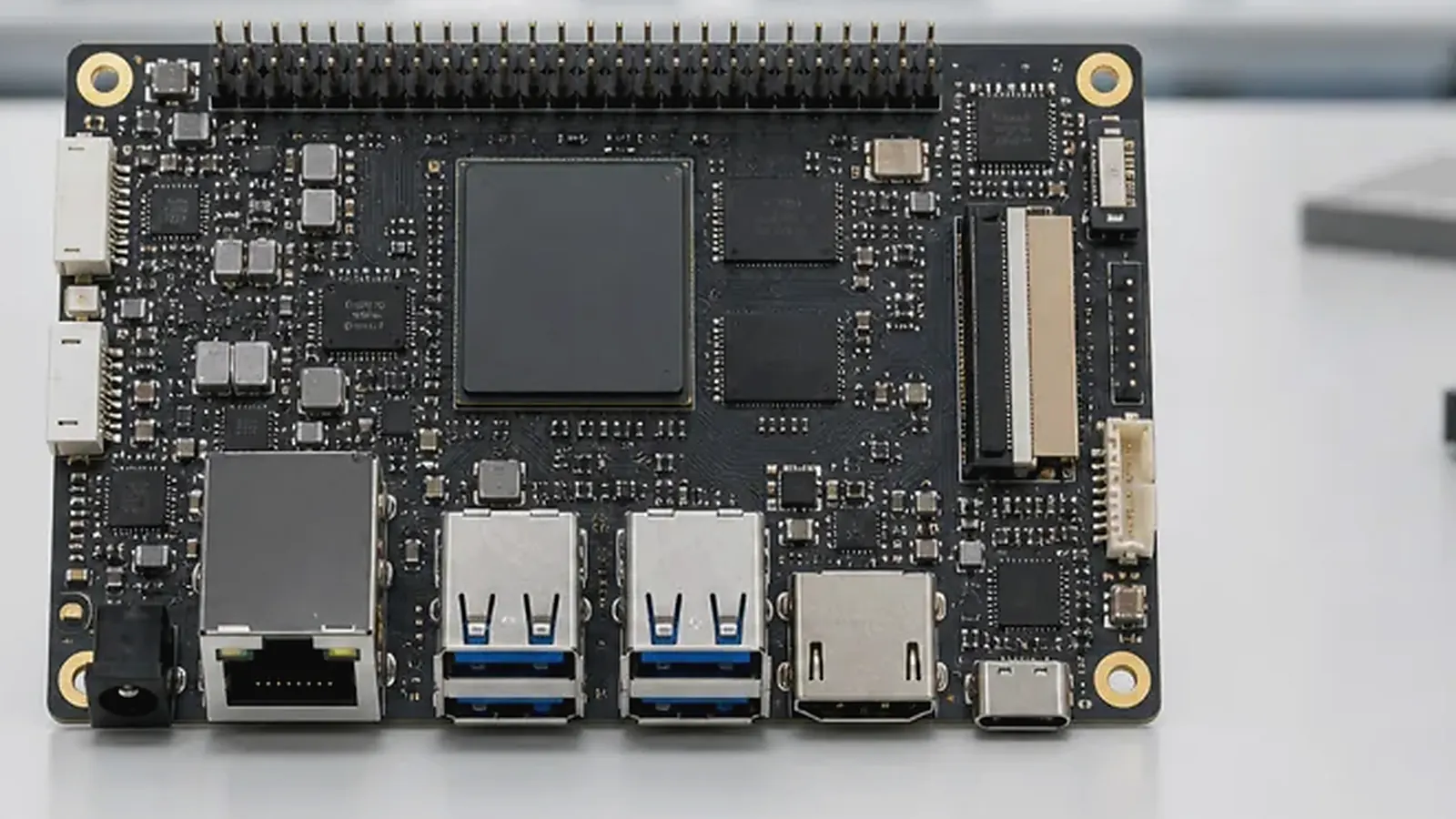
A Rockchip Linux SBC can be a good fit for gateways, industrial control products, edge devices, data collectors, and communication terminals when the product needs more than a small microcontroller but does not need a full PC-class platform. The value is not only processor performance. For Linux products, the important questions are interface support, BSP maturity, service startup, power recovery, enclosure fit, and production testing.
For Rockchip Linux SBC for Gateway and Industrial Control Projects, production readiness depends on repeatable I/O tests, not only a working prototype. Each Ethernet, serial, GPIO, relay, USB, storage, and power-recovery item should have a pass/fail method that the factory can run without engineering judgment on every unit.
Product teams often look at Rockchip when they need Ethernet, USB, serial ports, storage, display output, wireless modules, and enough application headroom for protocol conversion or local processing. The board still needs to be matched carefully to the field environment.
Define the gateway or control role
A gateway collects data, bridges protocols, connects field devices, and sends information to a server or local system. It may need Ethernet, Wi-Fi, LTE, RS485, CAN, USB, local storage, RTC, watchdog, and secure update behavior. A control product may need GPIO, relays, serial ports, deterministic startup, and reliable recovery after power loss.
If the project is mainly about background services and field interfaces, start from the Linux SBC direction. If it also needs rugged wiring, long-running deployment, and practical installation details, compare the Industrial SBC direction as well.
Interface planning comes first
Most Rockchip Linux gateway discussions should begin with an interface table. The exact number and type of ports matter more than broad phrases like “industrial I/O.”
| Interface | Questions to confirm |
|---|---|
| Ethernet | Number of ports, speed, PHY, PoE or standard power |
| Serial | UART, RS485, RS232, direction control, isolation |
| CAN/GPIO | Pin count, voltage level, protection, connector style |
| Wireless | Wi-Fi, Bluetooth, LTE, antenna location, module supply |
| Storage | eMMC, SD card, log size, database needs, write endurance |
| Service access | Debug port, USB service port, reset, recovery method |
For a standard Rockchip SBC, some interfaces may be available but not routed in the way the enclosure needs. For a production gateway, connector direction and field wiring can be as important as electrical support.
Kernel, device tree, and driver checks
Rockchip Linux projects depend on bootloader, kernel, device tree, root filesystem, and drivers. Engineers should ask which Linux kernel version is supported, which interfaces are already tested, and what changes are needed for the final hardware. The official Linux kernel documentation is a strong technical reference, but product delivery depends on board-specific BSP adaptation.
Driver checks need to cover Ethernet PHY, Wi-Fi/Bluetooth module, USB host behavior, serial ports, RS485 transmit control, CAN, GPIO, storage, RTC, watchdog, display if used, and any sensor or module attached through I2C or SPI. If the product changes a component from the reference board, schedule driver validation.
Service startup and field behavior
Linux gateway and control products should boot predictably and start required services without manual operation. The system may need a custom startup sequence, watchdog, automatic network reconnect, log rotation, filesystem protection, and remote update method. These details are product requirements, not optional cleanup.
Power recovery should also be tested. What happens if the device loses power while writing logs? Does it restart services correctly after a network outage? Can it recover if an application crashes? A field product needs testing under the failures it is likely to see.
Choosing between RK3566, RK3576, RK3399, and others
RK3566 can be a practical choice for many gateway, control, and connected terminal products when the interface set and performance target are moderate. RK3576 or RK3399 may be considered when the product needs stronger application processing, display output, camera, local AI, or heavier edge workloads. RK3308 may fit more compact audio or voice-connected Linux products.
The best answer depends on the board design and BSP, not only the SoC. A platform with proven drivers and suitable connectors can be better than a stronger processor that creates integration risk.
Standard board versus custom gateway board
A standard board is useful for software development and small-volume products. A Custom SBC becomes more attractive when the product needs terminal blocks, isolated RS485, dual Ethernet, custom power input, antenna placement, enclosure-specific mounting, or a controlled BOM. Customization can also simplify production testing and reduce adapter cables.
If the product has fixed enclosure drawings or field wiring requirements, custom board review should start before the industrial design is frozen. Otherwise, the project may end up with a board that works electronically but is difficult to install or test.
Production testing
Production testing for a Rockchip Linux gateway needs to cover image flashing, Ethernet, wireless, serial, CAN, GPIO, storage, watchdog, service startup, power recovery, and identifiers such as MAC address or serial number. A test fixture should be planned early if the product has many field interfaces.
For related planning, read board requirements for Linux gateways and controllers and kernel, device tree, rootfs, and driver support. These articles help connect interface planning with Linux software delivery.
When comparing samples, run the same rootfs and service load on each board if possible. Otherwise the faster-looking board may simply be running fewer services, less logging, or a lighter network configuration.
Final recommendation
Use a Rockchip Linux SBC when the product needs embedded Linux flexibility, practical I/O, and enough performance for gateway or control workloads. Choose the exact board by interface support, BSP readiness, field behavior, enclosure fit, and production testing rather than by processor name alone.
Frequently Asked Questions
What details are useful before we talk about a Rockchip SBC build?
Send the use case, OS preference, display or I/O list, enclosure limits, power input, wireless needs, target quantity, and timing. With that context, Avontek can suggest a Rockchip SBC hardware path that fits the real device instead of only comparing board specifications.
When is a custom SBC worth considering for a Rockchip SBC product?
A custom SBC is worth reviewing when the device needs a fixed PCBA outline, connector position, display interface, power input, wireless module, mounting method, or cost target that a catalog board cannot meet cleanly.
Can Avontek stay involved after Rockchip SBC samples are built?
Yes. Avontek can help with Rockchip SBC board choice, Android or Linux BSP discussion, peripheral checks, sample bring-up, test fixtures, image review, and factory coordination.