
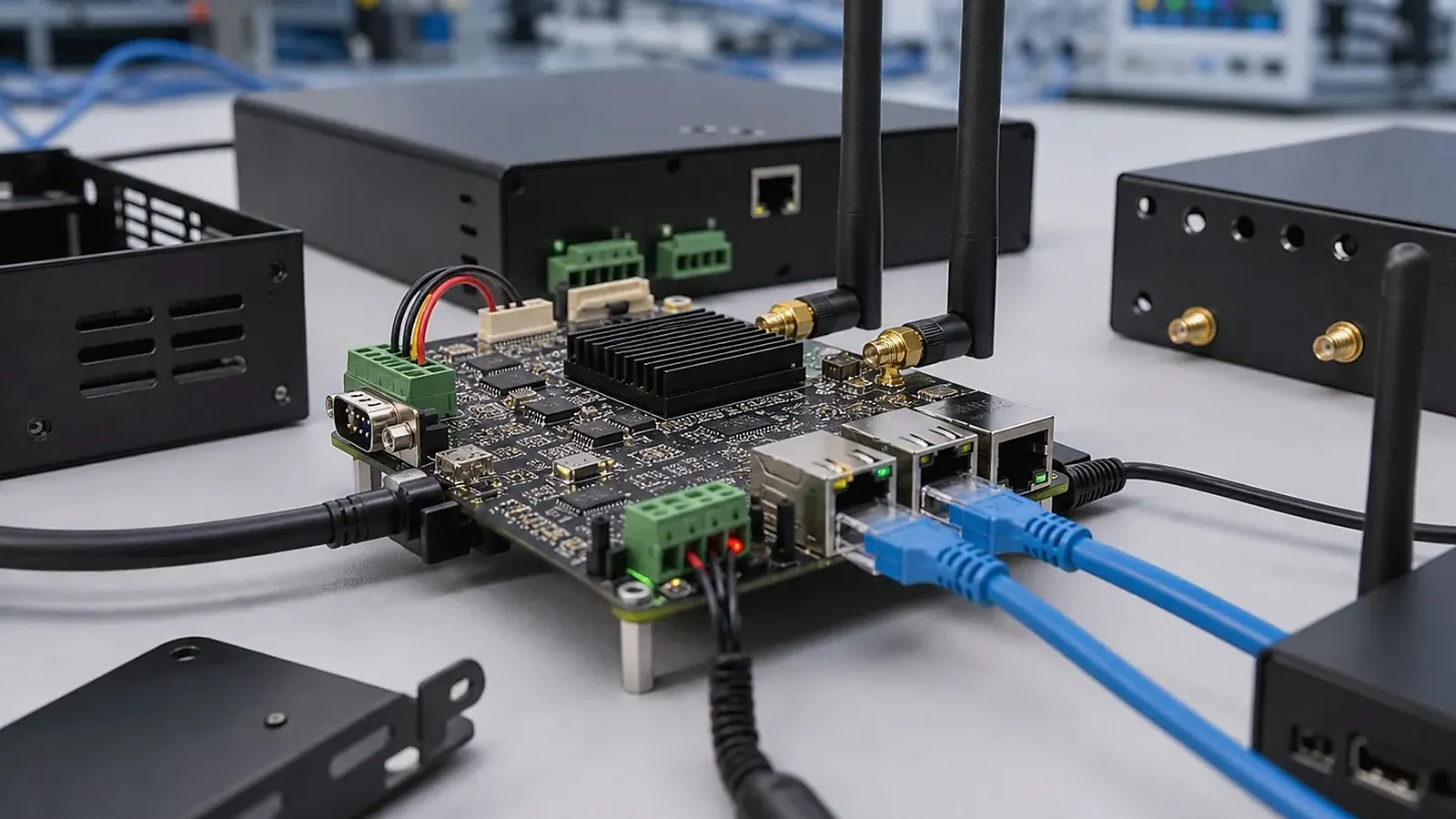
Choosing a Linux IoT gateway SBC is mostly about interfaces, software reliability, field behavior, and production repeatability. A gateway may collect data from sensors, bridge protocols, connect equipment to a cloud platform, run local rules, buffer logs, and recover automatically after network or power failure. The board must support the right I/O, but it also needs a Linux image, drivers, service startup, storage plan, enclosure fit, and factory test process.
For Linux IoT Gateway SBC Selection Guide for Connected Edge Products, the strongest early test is not a dashboard screenshot. It is a long run with unstable network, real serial devices, power interruptions, log rotation, and a forced restart. That test exposes whether the gateway behaves like field equipment or only like a development bench.
For product teams building industrial gateways, connected edge devices, data collectors, protocol bridges, or field communication terminals, the IoT Gateway SBC direction should begin with the device role and installation environment.
Define the gateway role
An IoT gateway can be a simple data uploader or a more capable edge device. It may connect to meters, PLCs, sensors, access systems, HVAC equipment, or production machines. It may use MQTT, HTTP, Modbus, CAN, local databases, remote update tools, and watchdog services. The role determines whether the project needs a standard Linux SBC, an Industrial SBC, or a Custom SBC.
If the gateway has a display and user workflow, Android may be considered, but most gateway products are better evaluated as Linux systems because stable services and interfaces are central.
Interface checklist
| Gateway requirement | What to confirm |
|---|---|
| Ethernet | Number of ports, speed, static IP, service access, PoE need |
| Serial | UART, RS485, RS232, direction control, isolation, connector |
| CAN/GPIO | Field device support, protection, voltage level, test method |
| Wireless | Wi-Fi, Bluetooth, LTE, antenna location, module supply |
| Storage | eMMC, SD card, log size, database, write endurance |
| Power | Input range, restart behavior, surge, standby, watchdog |
| Service access | Debug UART, USB, recovery mode, reset, remote support |
Each interface should be tied to a product function. “Need RS485” should become “two isolated RS485 ports for Modbus RTU, with terminal blocks and loopback test.” That level of detail helps avoid board rework.
Linux BSP and service startup
Linux gateway projects need bootloader, kernel, device tree, root filesystem, drivers, network configuration, service startup, logs, watchdog, and update planning. The official Linux kernel documentation is useful background, but the production result depends on board-specific BSP and driver validation.
Ask the supplier which kernel version, interfaces, wireless modules, storage devices, and flashing methods are supported. Also confirm whether the gateway application starts automatically, recovers after a crash, and preserves logs safely after power loss.
Storage planning deserves special attention. Gateways often write logs, local databases, and buffered messages when the cloud is unavailable. If the storage device has weak write endurance or the filesystem is not protected, field failures may appear months after deployment. Define how much data is stored, how long it is retained, and how logs are rotated.
Rockchip or Allwinner gateway platforms
Rockchip SBC platforms can fit gateways that need more processing headroom, display output, camera, local analytics, or heavier services. Allwinner SBC platforms can fit cost-sensitive gateway, control, audio, or compact connected products when the interface list is controlled. The right choice depends on Linux support, I/O, supply, and production testing.
Do not select only by processor name. A proven Linux image and tested interfaces can be more valuable than a stronger processor with unclear driver support.
Enclosure and production planning
Gateways are often installed in cabinets, equipment rooms, or field boxes. Connector direction, terminal access, antenna placement, cable strain relief, heat, labels, and mounting holes need review before layout is locked. A custom board may reduce adapters, improve field wiring, and simplify test fixtures.
Production testing needs to verify Ethernet, serial ports, wireless modules, USB, storage, GPIO, watchdog, service startup, image version, MAC address, and serial number. For related reading, see field I/O mapping for IoT gateways and kernel, device tree, rootfs, and driver support.
Pilot deployment needs to use real field devices, real cables, and the expected power supply. Test network loss, cloud timeout, power cycling, and weak wireless signal. These conditions are common in deployed gateways and should be validated before the production order scales.
Procurement should also confirm accessory and lifecycle details: antenna, terminal plugs, power adapter, enclosure, labels, packaging, and follow-up batch availability. A gateway project can be delayed by a small mechanical or accessory change if it affects installation or certification.
Buyers should ask for a sample validation report before approving production. The report should list tested interfaces, Linux image version, gateway application version, storage configuration, wireless module, and known limitations. This makes later batch comparison much easier.
It should also identify the approved enclosure and accessory set.
Final recommendation
Choose a Linux IoT gateway SBC by field role, interface list, BSP readiness, service behavior, enclosure fit, testing, and supply. The best gateway board is the one that can run unattended, recover predictably, and be built repeatedly in production.
Frequently Asked Questions
What details are useful before we talk about an IoT Gateway build?
Send the use case, OS preference, display or I/O list, enclosure limits, power input, wireless needs, target quantity, and timing. With that context, Avontek can suggest a IoT Gateway hardware path that fits the real device instead of only comparing board specifications.
When is a custom SBC worth considering for an IoT Gateway product?
A custom SBC is worth reviewing when the device needs a fixed PCBA outline, connector position, display interface, power input, wireless module, mounting method, or cost target that a catalog board cannot meet cleanly.
Can Avontek stay involved after IoT Gateway samples are built?
Yes. Avontek can help with IoT Gateway board choice, Android or Linux BSP discussion, peripheral checks, sample bring-up, test fixtures, image review, and factory coordination.