
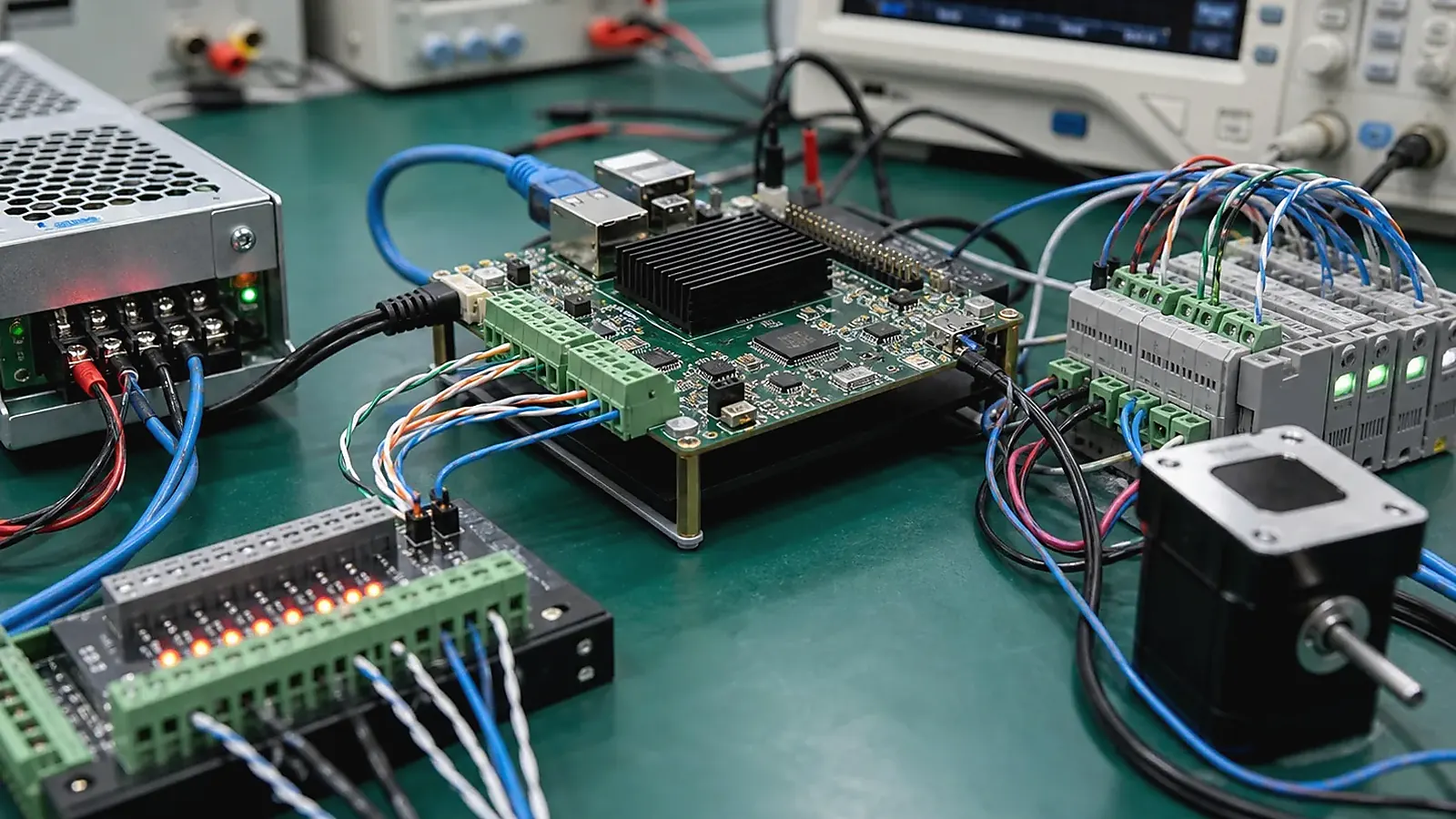
Linux industrial control board software should be planned as a field system, not only as an image that boots. The product may need to start services automatically, communicate through Ethernet or serial ports, log failures, recover after power loss, handle watchdog events, protect storage, and support updates across deployed units. These behaviors decide whether the device can run unattended.
For Linux Industrial Control Board Software: BSP, Services, Watchdog, Logs, and Updates, the BSP conversation should list what is already working and what still needs bring-up. Display, touch, Ethernet, Wi-Fi, Bluetooth, camera, audio, storage, GPIO, watchdog, and update behavior may sit in different parts of the SDK, so vague driver promises are hard to manage.
For industrial control products, a Linux SBC is often selected because Linux can support services, drivers, networking, protocol stacks, storage, logs, and update tools. The board still needs product-specific BSP and validation.
BSP scope
Linux BSP work may include bootloader, kernel version, device tree, root filesystem, Ethernet PHY, serial ports, RS485 direction control, CAN, GPIO, USB, storage, RTC, watchdog, display, wireless, and factory flashing. The official Linux kernel documentation is useful technical background, but production support depends on the actual board and selected components.
For a Custom SBC, BSP scope needs review against the schematic and BOM. Changing a wireless module, Ethernet PHY, PMIC, or storage part may require software changes.
Service startup and recovery
Industrial devices should start required services without manual login. Define service order, network dependencies, log location, restart policy, and what happens if a service crashes. Watchdog behavior needs testing; it should recover the system without hiding the root cause from logs.
| Software area | What to define |
|---|---|
| Boot | Bootloader, image source, startup time, recovery mode |
| Services | Startup order, dependencies, restart policy |
| Drivers | Ethernet, serial, CAN, GPIO, USB, storage, wireless |
| Logs | Rotation, storage location, remote collection, error codes |
| Watchdog | Timeout, trigger policy, recovery behavior |
| Updates | Local, remote, factory-only, rollback, version control |
Project managers should ask for clear image version naming and change logs. Procurement should know whether future batches will receive the same tested image.
The service plan should also include dependency failures. What happens if Ethernet is not ready, a serial device is missing, storage is full, or a configuration file is damaged? Industrial software should fail in a way that can be logged, diagnosed, and recovered.
Storage and power failure
Industrial control boards often write logs or local data. Sudden power loss can corrupt files if the storage and filesystem are not planned. Define write frequency, log size, database use, filesystem protection, and backup strategy. If the product runs in a harsh environment, test repeated power cycles.
Power recovery needs to be part of acceptance testing. The device should restart, launch services, reconnect interfaces, and report useful logs. If human action is required, the product may not be suitable for unattended control.
Storage choices need review with procurement. eMMC capacity, write endurance, SD card use, and approved alternates can affect reliability. If the product stores logs or local data for months, the storage plan should be validated under realistic write patterns rather than a short demo.
Interface software
RS485, CAN, Ethernet, GPIO, and USB need software validation under real workloads. For RS485, confirm direction control and protocol timing. For CAN, confirm bitrate and error handling. For GPIO, confirm voltage, debounce, and permissions. For Ethernet, test reconnect and fixed IP or DHCP behavior.
If the product includes a display or HMI, compare the HMI SBC direction. If it is mainly a controller or gateway, compare Industrial SBC and IoT Gateway SBC requirements.
Application and BSP boundaries should be documented. The board supplier may own kernel, drivers, image preparation, and flashing tools, while the customer owns control logic, protocol application, and cloud connection. Clear ownership prevents delays when field issues appear.
Production and field support
Factory testing needs to verify image version, service startup, Ethernet, serial ports, GPIO, storage, watchdog, and power recovery. Field support needs to cover a way to identify the software version, collect logs, reset configuration, and restore a known-good image.
For broader BSP context, read kernel, device tree, rootfs, and driver support and hardware design priorities for industrial controllers.
Update strategy should be agreed before deployment. Some industrial products allow remote updates, while others require factory-only image changes. If remote updates are used, define rollback, credentials, network requirements, and what happens if power is lost during the update.
Support documentation needs to cover service names, log locations, version commands, recovery steps, and common fault checks. This makes the device supportable by technicians rather than only by the original software engineer.
For production, keep a golden image and a tested recovery process. A field unit should be restorable to a known state without guessing which files or packages were used during development.
For control boards, one useful review is to unplug the upstream network while the local serial device keeps running. The application should not block forever waiting for the cloud, and the log should still tell support what happened.
Final recommendation
Plan Linux industrial control software around real field behavior: BSP, drivers, services, watchdog, logs, storage, updates, and recovery. A stable Linux image is one that can run, fail, recover, and be diagnosed in the installed product.
Frequently Asked Questions
What details are useful before we talk about an Industrial Control build?
Send the use case, OS preference, display or I/O list, enclosure limits, power input, wireless needs, target quantity, and timing. With that context, Avontek can suggest a Industrial Control hardware path that fits the real device instead of only comparing board specifications.
When is a custom SBC worth considering for an Industrial Control product?
A custom SBC is worth reviewing when the device needs a fixed PCBA outline, connector position, display interface, power input, wireless module, mounting method, or cost target that a catalog board cannot meet cleanly.
Can Avontek stay involved after Industrial Control samples are built?
Yes. Avontek can help with Industrial Control board choice, Android or Linux BSP discussion, peripheral checks, sample bring-up, test fixtures, image review, and factory coordination.