
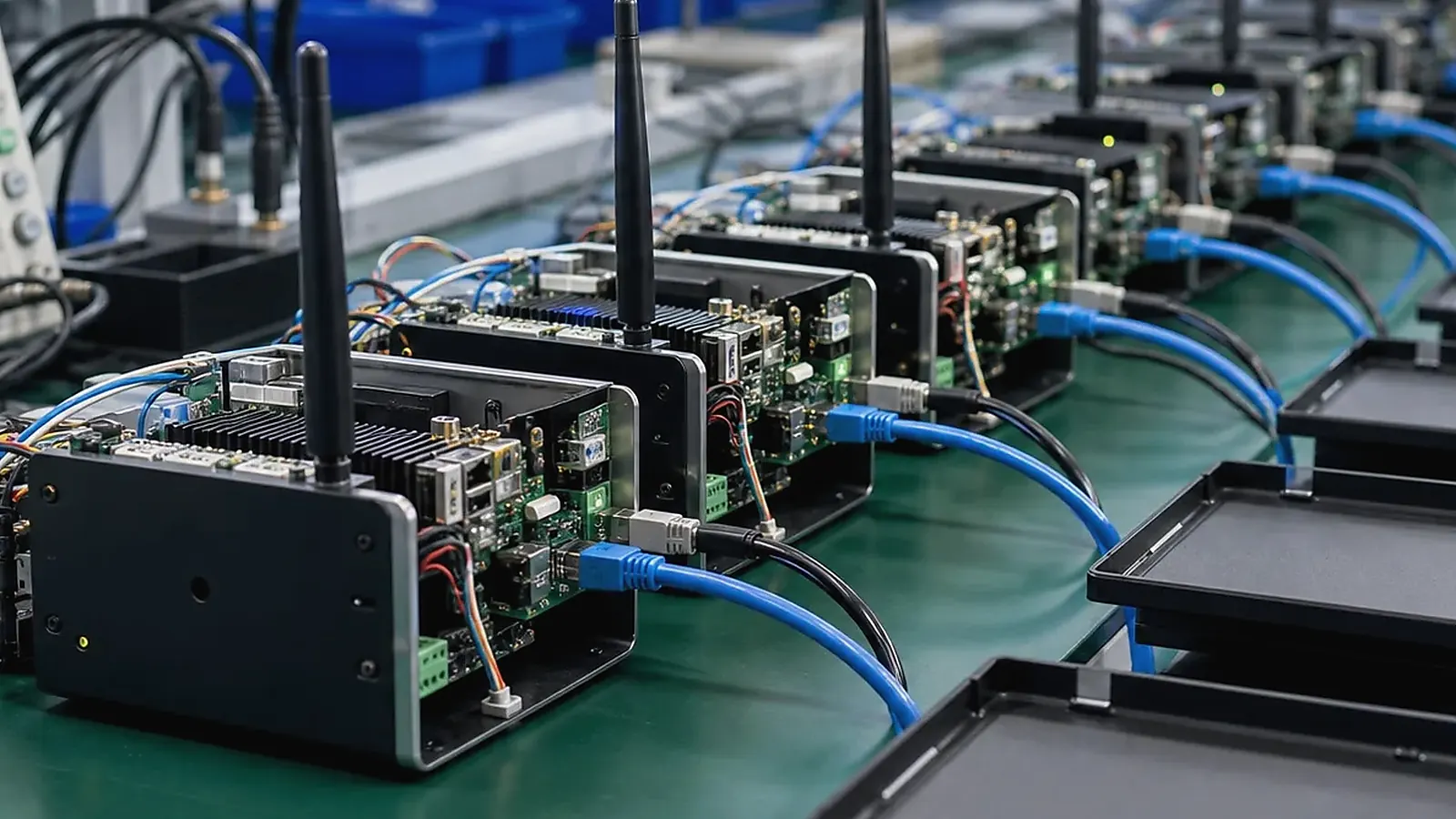
An industrial IoT gateway is only useful if it survives the real installation environment. The product may work in a lab, but deployment introduces long cables, weak wireless coverage, power interruptions, noisy equipment, cabinet heat, installer mistakes, and network changes. A deployment and production checklist helps the team validate the gateway before it reaches the field.
For Industrial IoT Gateway Deployment, Testing, and Production Checklist, production readiness depends on repeatable I/O tests, not only a working prototype. Each Ethernet, serial, GPIO, relay, USB, storage, and power-recovery item should have a pass/fail method that the factory can run without engineering judgment on every unit.
For industrial gateway projects, start from the IoT Gateway SBC requirement and connect it with Industrial SBC expectations around wiring, power, enclosure, and field reliability.
Field installation checklist
The gateway should be planned around the site where it will be installed. Confirm cabinet space, mounting method, connector direction, cable entry, antenna location, power input, grounding, and service access. A compact board may still be difficult to deploy if the installer cannot reach terminals or read labels.
| Deployment item | What to check |
|---|---|
| Mounting | DIN rail, wall mount, screws, enclosure depth |
| Wiring | Ethernet, RS485, CAN, power, terminal labels, cable strain |
| Wireless | Wi-Fi/LTE signal, antenna position, metal enclosure effects |
| Power | Input range, surge, restart after outage, backup need |
| Service | Reset, debug, USB, logs, firmware version, replacement process |
| Environment | Heat, dust, vibration, cable length, electrical noise |
If a standard board creates wiring or mounting problems, a Custom SBC can improve connector placement, power input, antenna routing, and test access.
Linux service reliability
Most industrial gateways use Linux because they need services, drivers, logs, network tools, protocol software, and remote update options. A Linux SBC project should define boot behavior, service startup, watchdog, log rotation, storage protection, network reconnect, and recovery after application failure.
The official Linux kernel documentation is useful technical background, but deployment reliability depends on board-specific BSP, service configuration, and field validation.
Factory testing checklist
Factory testing needs to match the gateway functions. A useful test flow may include:
1. Flash Linux image and record image version.
2. Write serial number, MAC address, and customer configuration.
3. Test Ethernet, RS485, CAN, USB, GPIO, storage, and wireless.
4. Start gateway services and confirm protocol communication.
5. Test watchdog, reboot, and power recovery behavior.
6. Save pass/fail result for production tracking.
Testing only boot and Ethernet is not enough if the product depends on serial ports, wireless, storage, or protocol services.
Pilot deployment
Pilot units should be installed at a real or representative site. Use actual cables, real field devices, expected power supply, and the real cloud or local server. Check network outages, device disconnects, power cycles, weak signal, and long-running service behavior.
Project managers should collect installation feedback from technicians. Procurement needs to confirm spare units, accessories, labels, and follow-up supply. Engineers should review logs and close issues before the production order scales.
Pilot deployment should run long enough to expose storage, thermal, and network behavior. A gateway can pass a one-hour demo but fail after days of logging, reconnecting, or buffering messages. Record CPU load, storage use, memory use, wireless signal, service restarts, and any watchdog events during the pilot.
Maintenance and support planning
A gateway should be serviceable without deep engineering support. Field teams need to identify software version, network status, device status, and error logs. If remote access is used, define security, credentials, update permission, and rollback strategy. If local service is required, define debug port access and reset behavior.
For related reading, see kernel, device tree, rootfs, and driver support and factory test coverage for embedded boards. These topics connect gateway software with production quality.
Support documentation needs to cover wiring diagrams, LED meanings, reset method, default network behavior, update process, and basic fault checks. This documentation is not only for end users; it also helps installers, distributors, and maintenance teams handle routine issues without escalating every case to engineering.
Spare unit planning is also part of deployment. If the gateway is installed in many cabinets or sites, the buyer needs to confirm replacement process, configuration backup, and whether a spare unit can be prepared with the same image and identifiers before shipment.
The final deployment package needs to cover the gateway unit, power and antenna accessories, wiring guide, software version record, test result, and contact path for technical escalation. This keeps field rollout organized.
For multi-site projects, keep one approved reference unit for comparison.
Maintenance teams should also keep the matching configuration file, cloud account status, and wiring photo for each installed site. These records shorten troubleshooting when a unit is replaced or moved.
Final recommendation
Validate an industrial IoT gateway through field wiring, Linux services, power recovery, wireless behavior, enclosure fit, factory testing, and pilot deployment. A gateway is production-ready only when it can be installed, tested, maintained, and repeated across batches.
Frequently Asked Questions
What details are useful before we talk about an IoT Gateway build?
Send the use case, OS preference, display or I/O list, enclosure limits, power input, wireless needs, target quantity, and timing. With that context, Avontek can suggest a IoT Gateway hardware path that fits the real device instead of only comparing board specifications.
When is a custom SBC worth considering for an IoT Gateway product?
A custom SBC is worth reviewing when the device needs a fixed PCBA outline, connector position, display interface, power input, wireless module, mounting method, or cost target that a catalog board cannot meet cleanly.
Can Avontek stay involved after IoT Gateway samples are built?
Yes. Avontek can help with IoT Gateway board choice, Android or Linux BSP discussion, peripheral checks, sample bring-up, test fixtures, image review, and factory coordination.