
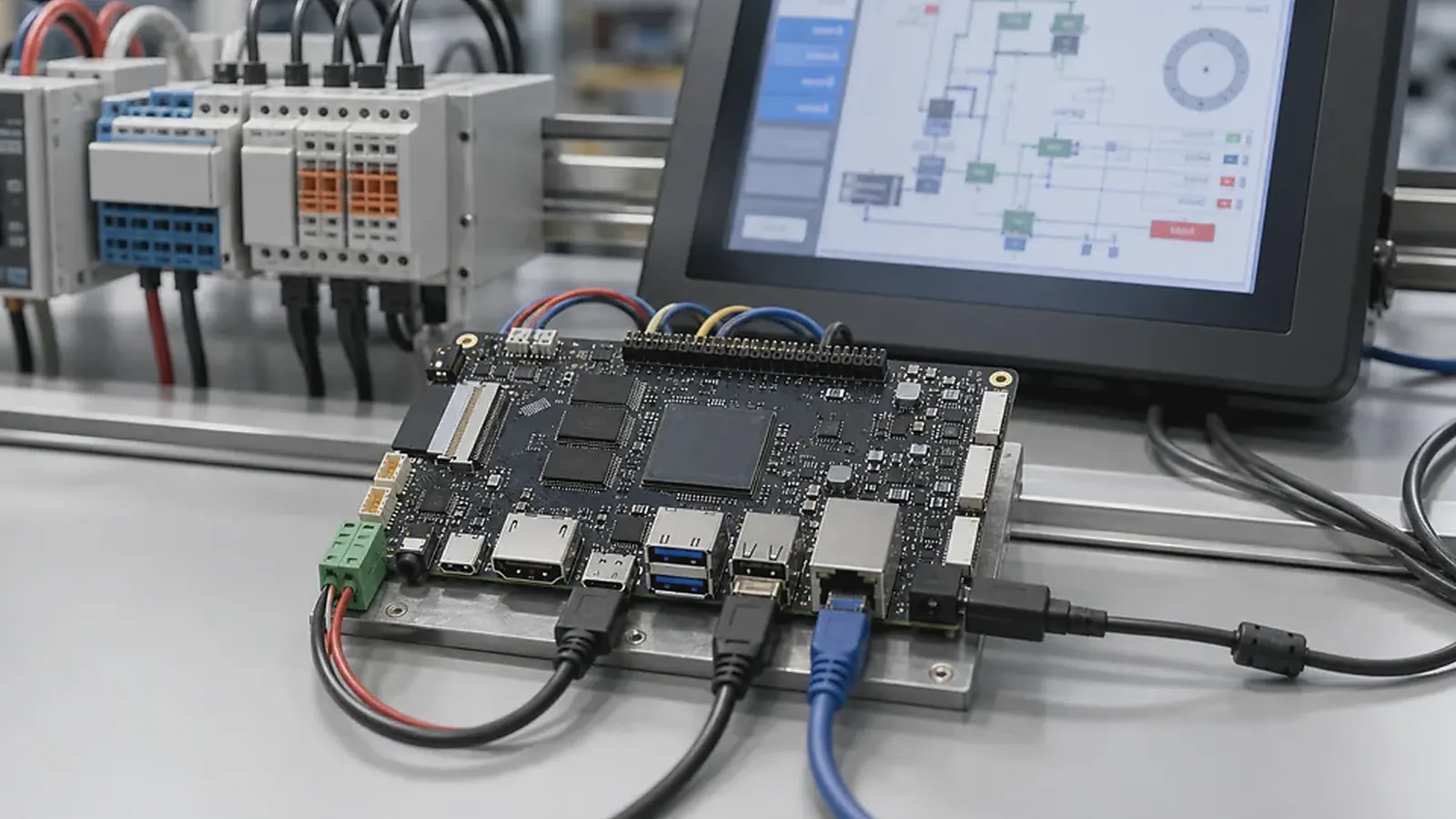
Choosing an industrial control SBC starts with the field environment. The board may run inside equipment, a cabinet, a machine interface, a data collection product, or a control terminal. It may need Ethernet, RS485, CAN, GPIO, USB, display, watchdog, storage, wireless, and reliable power recovery. The best board is not the one with the longest feature list; it is the one that supports the required control behavior and can be installed, tested, and supplied consistently.
Industrial control pages need a site-level review. For Industrial Control SBC Selection Guide for Automation and Equipment Products, consider cabinet temperature, cable length, grounding, power quality, RS485 or CAN noise, DIN or panel mounting, service access, and how a technician will replace the unit without guessing at wiring or firmware version.
For automation and equipment products, begin with the Industrial Control SBC requirement rather than a generic development board. Industrial control products need stable interfaces, clear wiring, predictable software startup, and practical production testing.
Define the control task
Start by describing what the device controls or monitors. A data collector may need Ethernet, RS485, storage, and a Linux service. A machine interface may need display, touch, GPIO, and serial communication. A field controller may need isolated I/O, watchdog, power recovery, and a rugged enclosure. These differences change board selection.
If the product is service-oriented, compare Linux SBC platforms. If it has a rich touchscreen UI, compare Android SBC options. If the enclosure, power, and field connectors are fixed, move toward Custom SBC planning early.
Hardware checklist
| Area | What to confirm |
|---|---|
| Network | Ethernet count, Wi-Fi, LTE, service port |
| Field I/O | RS485, RS232, CAN, GPIO, relay, isolation |
| Display | HDMI, LVDS, MIPI, RGB, touch if required |
| Power | Input voltage, surge, restart, backup, watchdog |
| Storage | eMMC, SD card, logs, local database, write endurance |
| Mechanics | Mounting, connector direction, cable strain, enclosure depth |
| Testing | Loopback, fixture access, serial number, image version |
Each item should be connected to a product function. “Need GPIO” should become input count, output count, voltage level, connector type, protection requirement, and factory test method.
For an RFQ, attach photos or drawings of the current equipment if available. A wiring photo, existing controller layout, cabinet drawing, or terminal diagram often explains the product faster than a text list. It also helps the supplier judge whether the request is a standard board selection, a carrier board, or a full custom mainboard.
Software and BSP direction
Industrial control boards usually depend on Linux because Linux supports services, logs, drivers, networking, protocol software, and update tools. The official Linux kernel documentation is useful technical background, but the production result depends on board-specific BSP, device tree, drivers, and system image control.
For Android industrial interfaces, confirm app startup, permissions, display, touch, serial access, and recovery behavior. For Linux products, confirm bootloader, kernel, root filesystem, service startup, watchdog, logs, and update plan.
Software ownership should be clear before samples are ordered. The supplier may provide BSP, drivers, flashing tools, and factory test support, while the customer owns control logic, cloud connection, or application UI. If this boundary is vague, field bugs can sit between teams instead of being solved.
Platform and customization
Rockchip SBC platforms can fit industrial products that need more processing, display, camera, or UI headroom. Allwinner SBC platforms can fit cost-sensitive control, gateway, audio, or compact connected products. The right answer depends on interface support, BSP maturity, supply, and production testing.
A custom industrial board becomes useful when terminal blocks, isolated ports, power input, mounting holes, connector direction, or enclosure fit cannot be solved cleanly by a standard board.
Customization should be evaluated by production volume and installation risk. If the product is only used in a small internal system, adapters may be acceptable. If the product will ship repeatedly or be installed by third parties, cleaner connector placement and fewer cables can reduce service cost.
Validation and production
Prototype testing needs to cover power, boot, Ethernet, serial, CAN, GPIO, storage, watchdog, display, wireless, and service startup. Pilot testing needs to use real field devices, real cables, and the final enclosure. Production testing should record image version, MAC address, serial number, interface results, and known limitations.
For related context, read hardware design priorities for industrial controllers and board requirements for Linux gateways and controllers.
Procurement should also confirm lifecycle items: connector availability, power component supply, wireless module status, storage model, enclosure accessories, and follow-up batch support. Industrial products often stay in production longer than consumer devices, so uncontrolled component substitutions can create software or test changes later.
Field validation needs to cover failure cases. Disconnect network, interrupt serial communication, power-cycle the unit during operation, and check whether logs and recovery behavior are useful. A control board that only works during ideal operation is not ready for equipment deployment.
The final approval package needs to cover hardware revision, software image version, interface test results, enclosure notes, accepted component list, and open issue list. This creates a baseline for later production batches and field support.
Before the purchase decision, ask the installer or service team to review the connector layout. They often notice blocked screw terminals, unclear LED positions, or cable bend problems before the issue reaches engineering.
Final recommendation
Choose an industrial control SBC from the control task backward: interfaces, power, operating system, enclosure, BSP, test process, and supply. A board is production-ready only when it can survive the installation environment and be tested repeatedly before shipment.
Frequently Asked Questions
What details are useful before we talk about an Industrial Control build?
Send the use case, OS preference, display or I/O list, enclosure limits, power input, wireless needs, target quantity, and timing. With that context, Avontek can suggest a Industrial Control hardware path that fits the real device instead of only comparing board specifications.
When is a custom SBC worth considering for an Industrial Control product?
A custom SBC is worth reviewing when the device needs a fixed PCBA outline, connector position, display interface, power input, wireless module, mounting method, or cost target that a catalog board cannot meet cleanly.
Can Avontek stay involved after Industrial Control samples are built?
Yes. Avontek can help with Industrial Control board choice, Android or Linux BSP discussion, peripheral checks, sample bring-up, test fixtures, image review, and factory coordination.