
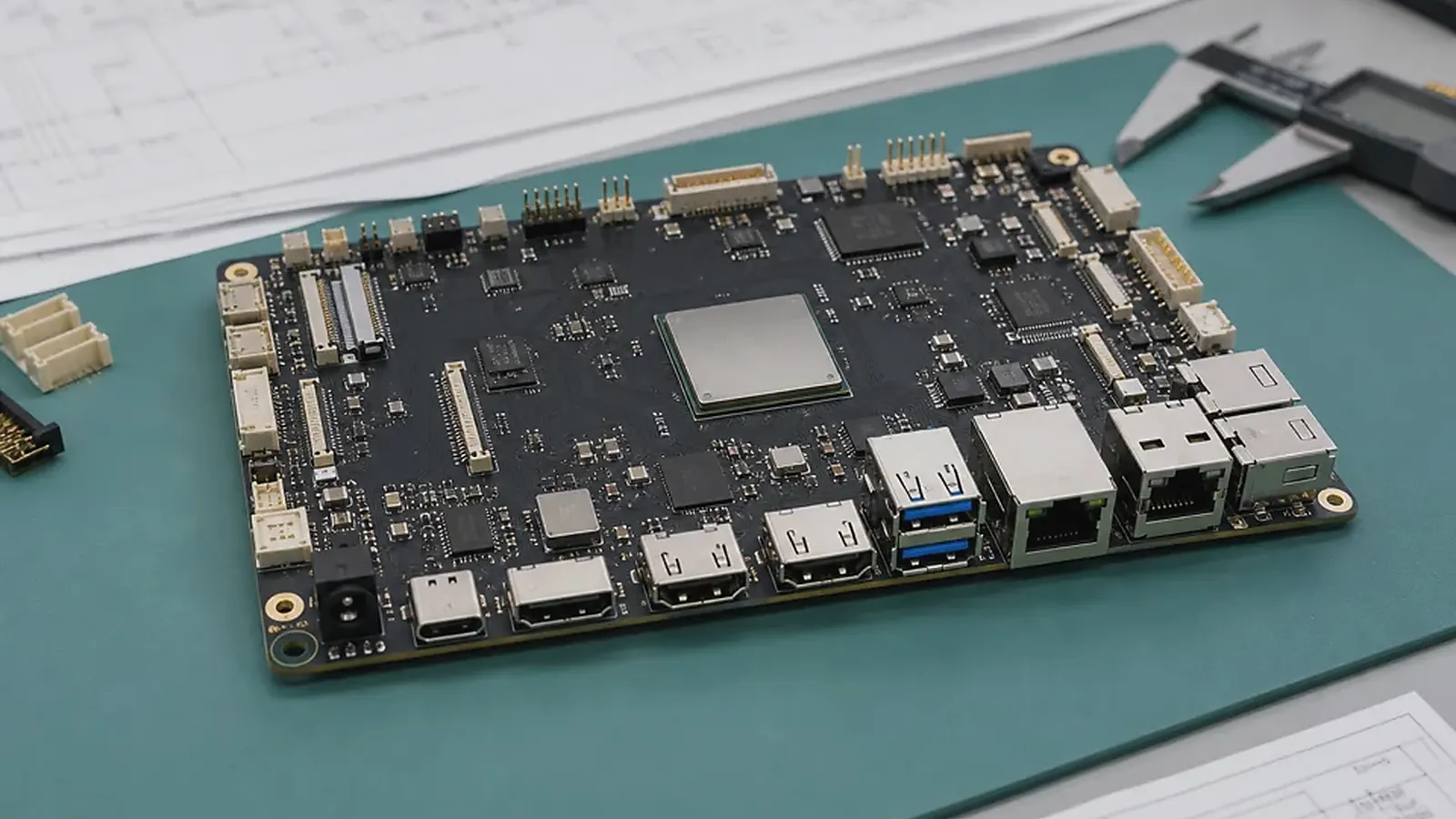
A standard Linux SBC is useful for evaluation, prototypes, and some low-volume products. It lets the team test the processor, Linux image, Ethernet, serial ports, GPIO, storage, and application services without starting a full hardware design. But many embedded products eventually need a board that matches the enclosure, interface count, connector direction, power input, field wiring, test fixture, and production cost target. That is where custom Linux board development becomes practical.
A custom SBC review should start with the physical product. For Custom Linux Board Development: From Standard SBC to Production-Ready Hardware, a supplier can give a better answer after seeing the enclosure drawing, mounting points, cable routes, connector direction, display part number, target quantity, and the functions that must stay unchanged from the sample stage to production.
The decision should be based on product constraints. A custom board adds design work and validation time, so it should solve real problems: mechanical fit, I/O mismatch, power requirements, cost optimization, long-term supply, or production testing.
When a standard Linux SBC is enough
A standard Linux SBC may be enough when the product volume is low, the enclosure is flexible, the interface set matches the board, and adapters do not create reliability or assembly issues. It is also useful for early software development, proof-of-concept gateways, lab equipment, internal tools, and pilot systems.
If the standard board can be mounted cleanly, all required interfaces are supported, thermal behavior is acceptable, and the supplier can support the same board for follow-up batches, staying standard may be the fastest path. Customization should not be treated as a default requirement.
Signs that custom hardware is needed
Custom Linux board development becomes more attractive when the standard board creates repeated compromises. Common signs include wrong connector direction, too many adapter cables, missing RS485 or CAN ports, insufficient Ethernet, unsuitable power input, awkward mounting holes, poor antenna position, blocked enclosure features, or a BOM that is too expensive for production quantity.
| Problem with standard SBC | Custom board benefit |
|---|---|
| Cables and adapters inside enclosure | Cleaner connector placement and assembly |
| Missing field interfaces | Built-in RS485, CAN, GPIO, Ethernet, or terminal blocks |
| Wrong power input | Product-specific power design and protection |
| Board does not fit enclosure | Custom outline, mounting holes, and height control |
| Too many unused features | BOM optimization and simpler production test |
| Hard to test in factory | Test points, fixture access, and defined flashing flow |
For field-installed products, a cleaner board can reduce service risk. For production products, it can also reduce assembly time and improve repeatability.
Define the Linux product before the PCB
Before schematic work begins, define what the Linux system must do. A gateway may need protocol conversion, MQTT, local logging, remote update, Ethernet, Wi-Fi, RS485, and watchdog recovery. An industrial controller may need isolated I/O, stable GPIO, deterministic startup, and power-failure recovery. A terminal may need display, touch, USB peripherals, audio, and a controlled UI.
These requirements influence processor choice, memory, storage, peripheral ICs, power design, and BSP scope. If the SoC family is not fixed, compare Rockchip SBC and Allwinner SBC options by interface support, Linux BSP maturity, cost, and supply.
BSP adaptation for custom Linux boards
Custom hardware usually needs Linux BSP adaptation. The board may need bootloader changes, kernel configuration, device tree updates, driver integration, GPIO mapping, Ethernet PHY setup, RS485 direction control, wireless module support, storage configuration, watchdog settings, and root filesystem changes.
The official Linux driver API documentation is a useful technical reference, but product delivery depends on practical board-level work: matching the schematic, validating each interface, preparing the system image, and testing the board under production conditions.
Power, enclosure, and field wiring
Linux control and gateway products often live in cabinets, equipment rooms, industrial panels, or commercial installations. Power input may need wider voltage tolerance, protection, terminal connectors, or restart behavior after outage. Field wiring may require screw terminals, isolation, surge protection, cable strain relief, and clear labeling.
The enclosure affects antenna placement, heat, connector access, service ports, and test fixture contact. These mechanical details need review before layout is locked. A technically correct PCB can still fail as a product if cables are hard to install or the board overheats after the enclosure is closed.
Production testing should be designed in
Custom boards need to cover production test access from the beginning. The factory may need to flash the Linux image, write serial numbers or MAC addresses, test Ethernet, Wi-Fi, Bluetooth, RS485, CAN, USB, GPIO, storage, display, audio, watchdog, and power behavior. Test points and fixture access need to be part of layout planning.
A simple production test flow may look like this:
1. Flash Linux image and write product identifiers.
2. Boot board and confirm image version.
3. Test Ethernet, wireless, USB, storage, serial, and GPIO.
4. Run product service startup test.
5. Trigger watchdog or power recovery check if required.
6. Save pass/fail result for production tracking.
For deeper manufacturing context, read factory test coverage for embedded boards. If the device is a gateway or controller, board requirements for Linux gateways and controllers is also relevant.
Final decision
Move from a standard Linux SBC to a custom Linux board when the final product needs cleaner mechanics, exact interfaces, field-ready power, controlled BOM, better test access, or repeatable production. The strongest custom projects start with a complete requirement list, then connect hardware design, embedded Linux BSP, enclosure planning, and manufacturing into one development path.
Frequently Asked Questions
What details are useful before we talk about a Linux SBC build?
Send the use case, OS preference, display or I/O list, enclosure limits, power input, wireless needs, target quantity, and timing. With that context, Avontek can suggest a Linux SBC hardware path that fits the real device instead of only comparing board specifications.
When is a custom SBC worth considering for a Linux SBC product?
A custom SBC is worth reviewing when the device needs a fixed PCBA outline, connector position, display interface, power input, wireless module, mounting method, or cost target that a catalog board cannot meet cleanly.
Can Avontek stay involved after Linux SBC samples are built?
Yes. Avontek can help with Linux SBC board choice, Android or Linux BSP discussion, peripheral checks, sample bring-up, test fixtures, image review, and factory coordination.