
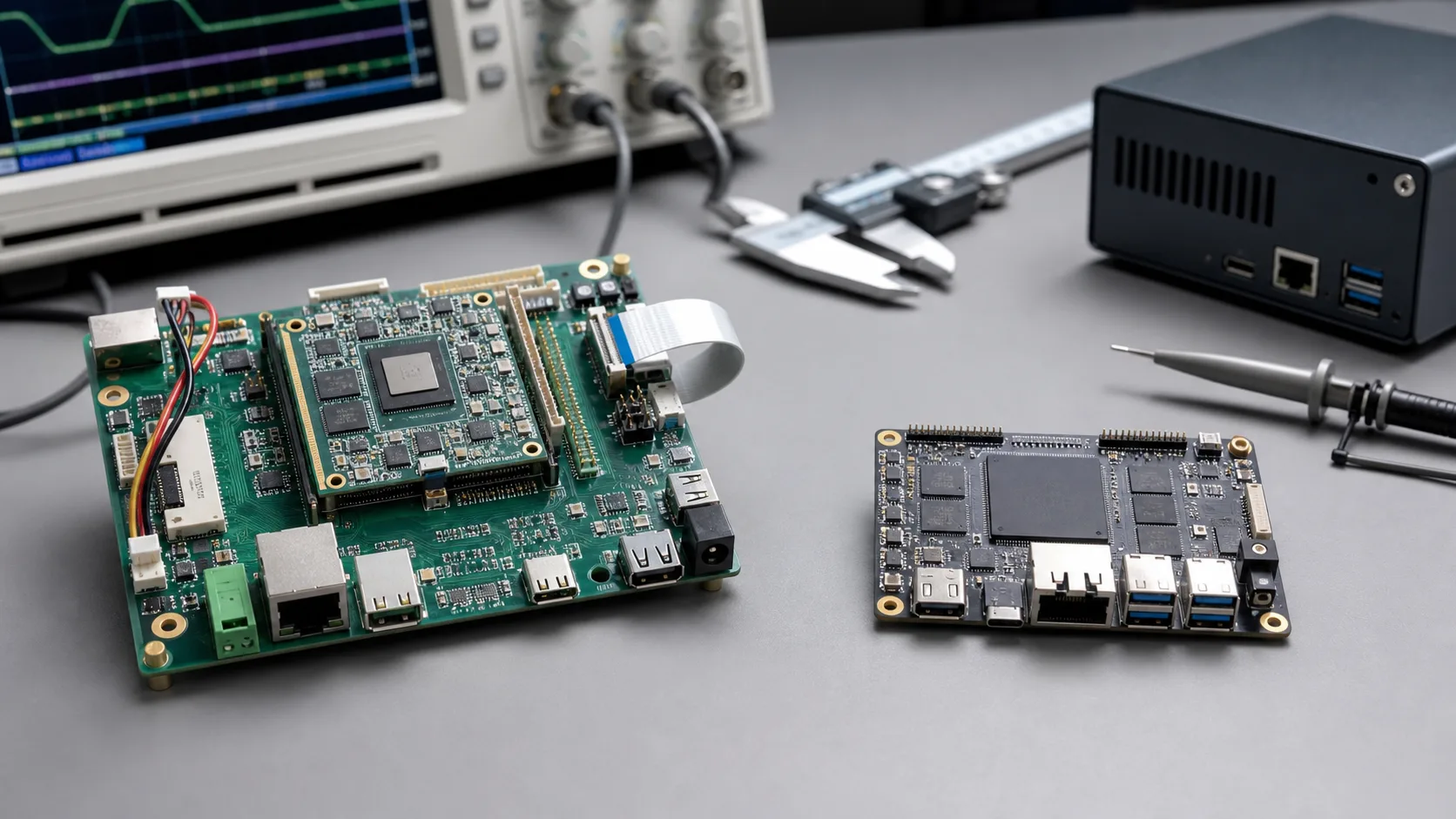
Choosing between a custom carrier board and a fully custom SBC is one of the first architecture decisions in an embedded product. Both paths can be correct. The wrong choice usually happens when the team decides too early from a single factor: lowest NRE, fastest sample, cleanest enclosure, or lowest unit cost.
A custom carrier board uses a compute module, SOM, or core board for the processor, memory, power management, and sometimes wireless or storage. The carrier board then provides the product-specific connectors, power input, mounting holes, display interface, field I/O, and mechanical fit. A fully custom SBC integrates the processor and peripheral design into one product-specific mainboard.
For many Custom SBC projects, the useful question is not “which one is more professional?” It is “which one reduces risk for this product at this stage?” A team validating a new Android HMI may need speed. A team building thousands of field gateways may need cost control and clean factory testing.
What a custom carrier board solves well
A custom carrier board is often the safer first step when the product requirement is not fully frozen. The compute module already has a known processor, memory, boot path, and BSP baseline. This can shorten early engineering time and reduce unknowns around DDR layout, PMIC behavior, high-speed routing, and system bring-up.
Carrier boards fit projects where the main problem is physical integration rather than core processor design. The product may need different connector positions, terminal blocks, display cable direction, GPIO access, RS485/CAN transceivers, or mounting holes that match the enclosure.
| Decision factor | Custom carrier board strength | Watch carefully |
|---|---|---|
| Schedule | Faster first samples if module is proven | Module lead time and vendor roadmap |
| BSP risk | Lower when module BSP is mature | BSP still changes if carrier I/O is unusual |
| Engineering scope | Less DDR/PMIC/high-speed design risk | Carrier layout still needs proper review |
| Volume | Good for pilot and moderate volume | Module cost may hurt larger production |
| Mechanical fit | Better than using an off-the-shelf SBC | Module height and connector stack may limit enclosure |
The carrier-board path is useful for proof-of-product builds, early customer samples, and products where application software needs to start before the final hardware is optimized.
Where fully custom SBC design becomes stronger
A fully custom SBC becomes attractive when the product is stable enough to justify deeper integration. Instead of stacking a module onto a carrier board, the design can place the SoC, memory, storage, power circuit, interfaces, wireless module, and connectors where the product needs them.
This matters when the enclosure is tight, connector direction is fixed, heat sources must align with metal parts, antennas need clean placement, or the factory wants fewer board-to-board connectors and cables. Compute modules save engineering time, but they usually carry a module margin, fixed component choices, and sometimes unused functions. At meaningful volume, those costs add up.
Fully custom SBC design is usually worth reviewing when:
- The product has a fixed enclosure and mounting structure.
- The display, touch, power input, and field connectors are already selected.
- The annual volume makes module cost noticeable.
- The team needs a controlled BOM and long-term component alternatives.
- Assembly needs to remove adapters, stacked connectors, or manual wiring.
- Production testing needs direct access to test pads, boot mode, debug UART, and identity writing.
The tradeoff is higher upfront work. DDR, PMIC, boot strap, high-speed interfaces, power integrity, thermal behavior, and BSP validation all need stronger review. For official manufacturing background, the IPC standards resources are useful, but each fully custom board still needs project-specific schematic, layout, DFM, and test planning.
The hidden cost question
Carrier boards often look cheaper because NRE is lower and the first sample is faster. Fully custom SBCs often look expensive because the design work is larger. A buyer should compare total cost across the expected product life, not only the first development quote.
Use a practical cost model:
total_project_cost =
  NRE
  + prototype_cost
  + pilot_rework_cost
  + unit_cost * expected_volume
  + assembly_time_cost
  + field_failure_risk
  + redesign_risk
For a 50-unit pilot, a carrier board may clearly win. For 5,000 or 20,000 units, the module premium, tall connector stack, manual assembly, and limited BOM control may become more expensive than a fully custom SBC.
Procurement should also ask what happens in year two. If the module vendor changes memory, wireless, storage, or BSP direction, the carrier-board project may inherit that change.
BSP and software risk
The software discussion should not be simplified to “carrier board is easy, fully custom is hard.” A proven module can reduce early BSP risk, but custom carrier I/O still needs validation. Ethernet PHYs, RS485, CAN, display, touch, audio codec, USB hub, LTE module, camera, and GPIO mapping can still require driver work.
For Android products, check display, touch, boot animation, launcher, permissions, app startup, Wi-Fi/Bluetooth, USB peripherals, and OTA behavior. For Linux products, check device tree, kernel drivers, services, watchdog, logs, network recovery, and update method. The architecture decision should include Android SBC or Linux SBC software scope, not only hardware cost.
Fully custom SBC work needs deeper BSP alignment because the schematic is no longer inherited from a module vendor. That can be a risk, but it also lets the board match the actual product workload instead of adapting around unused module interfaces.
Mechanical and production reality
Many architecture decisions are decided by the enclosure, not the processor. A carrier board with a compute module may be technically correct but too tall for a slim wall panel. A fully custom SBC may be more work but easier to mount, cool, test, label, and assemble.
Before choosing the path, place real mechanical constraints on the table: board outline, mounting holes, maximum component height, connector exits, antenna area, heat sink contact, display cable bend radius, service port access, label position, and test fixture access. Read mechanical coordination for custom PCBAs if the product enclosure is already fixed.
Production testing also changes the decision. A fully custom SBC can put test pads, debug UART, boot mode control, and fixture contact areas where the factory needs them. A carrier board can do this too, but the module may hide signals or require board-to-board connector checks. For repeatable manufacturing, review factory test coverage for embedded boards early.
A simple decision framework
Use the carrier-board path when the product needs speed, the volume is uncertain, the module BSP is mature, the enclosure can accept the module height, and the main customization is connector or I/O routing. This is often the right path for evaluation batches, pilot projects, and products where software validation is more urgent than hardware optimization.
Use the fully custom SBC path when requirements are stable, annual volume is meaningful, enclosure and connector locations are strict, unit cost matters, supply control matters, and production testing must be clean. This is often the better path for products that will stay in production for years.
| Product situation | Better starting point |
|---|---|
| Early market validation | Custom carrier board |
| Customer demo with changing requirements | Custom carrier board |
| Slim enclosure or fixed connector wall | Fully custom SBC |
| High-volume cost target | Fully custom SBC |
| Mature product replacing adapter cables | Fully custom SBC |
| Urgent software proof with known module | Custom carrier board |
Final recommendation
Do not choose the architecture from NRE alone. A custom carrier board can be the fastest and most practical path when the product is still learning. A fully custom SBC can be the cleaner production path when the enclosure, I/O, BOM, cost, and testing needs are stable.
The best RFQ gives the supplier enough context to compare both paths: product use, OS, display, interfaces, enclosure drawing, power input, quantity, lifecycle expectation, test requirements, and target schedule. Avontek can review those inputs and recommend whether a carrier-board design, standard SBC adaptation, or fully custom SBC development is the more practical route.
Frequently Asked Questions
Is a custom carrier board cheaper than a fully custom SBC?
It is often cheaper and faster for prototypes and moderate-volume products because the compute module already handles the processor, memory, and some BSP risk. At higher volume, the module cost and mechanical limits may make a fully custom SBC more attractive.
When should a product move from a carrier board to a fully custom SBC?
Move toward a fully custom SBC when the product has stable requirements, meaningful production volume, strict enclosure constraints, cost pressure, special I/O, controlled BOM needs, or repeated assembly problems caused by modules, adapters, and cables.
Can Avontek help compare both architecture paths?
Avontek can review product requirements, enclosure drawings, interface lists, OS and BSP scope, quantity, testing needs, and cost targets to compare a custom carrier board path against a fully custom SBC path.
Frequently Asked Questions
Is a custom carrier board cheaper than a fully custom SBC?
It is often cheaper and faster for prototypes and moderate-volume products because the compute module already handles the processor, memory, and some BSP risk. At higher volume, the module cost and mechanical limits may make a fully custom SBC more attractive.
When should a product move from a carrier board to a fully custom SBC?
Move toward a fully custom SBC when the product has stable requirements, meaningful production volume, strict enclosure constraints, cost pressure, special I/O, controlled BOM needs, or repeated assembly problems caused by modules, adapters, and cables.
Can Avontek help compare both architecture paths?
Avontek can review product requirements, enclosure drawings, interface lists, OS and BSP scope, quantity, testing needs, and cost targets to compare a custom carrier board path against a fully custom SBC path.